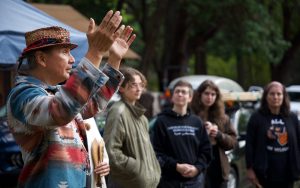

Paul Chiyokten Wagner is an activist, a tribal member of the W̱SÁNEĆ (Saanich) Nation, and the Founder of Protectors of the Salish Sea, an Indigenous-led environmental protection organization. But ask him about his spirit, and he will tell you about the night the flute songs came.
He used to play electric guitar, deep in rock bands, until a voice arrived that was not his own. Spirit music will reach you. He didn’t understand it. He told his bandmates he had to do something different. Eventually, that chapter closed, and he sat alone, waiting.
He waited a year.
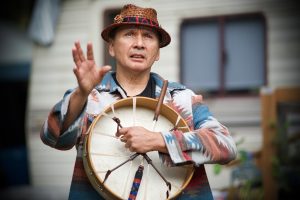
Photograph by Darrell Kirk
The Instruments Find Him
At a Saturday market, Wagner walked past a woman selling native flutes. He already had one. He kept walking. Then the voice came again: go back and talk to her. He turned around. He tried a few flutes, bought three. That night and into the morning, songs poured through him through the instruments.
“Those songs are from our ancestors,” he says. “Those songs are from the spirit of this land here in our Salish Sea and from the waters of our Salish Sea. I did not compose any of those songs.”
It took 12 years to receive 12 songs. He recorded them as his first native flute album, which won a National Music Award. He has since made four albums, and builds the instruments he plays—a flute maker and drum maker who harvests cedar only with ceremony, a hand held over the wood, words spoken, a sacred promise made.
He also plays the mbira, a 24-key instrument of the Shona people of Zimbabwe.
“They call it a telephone to the ancestors of the Shona people,” he says. “If they play well enough, the ancestors will show up, and they will answer questions or resolve problems in a village or a relationship between two people.”
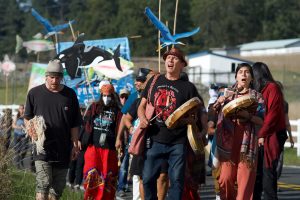
Photograph by Darrell Kirk
The Voice of the Voiceless
Gretchen Krampf, who is a process consultant and strategic advisor, has witnessed Wagner bring this music into the wider world.
“I think Paul is one of those bridges to sharing wisdom in a way that is respectful and informative, giving those of us who are not indigenous to this land what we need to know. Using the traditional songs and the traditional instruments has been part of his gift,” she says.
Ben Browner, production lead of Revival Gatherings, produced a 1,000-person choir in-the-round at St. Mark’s Cathedral in Seattle last November called THE CIRCLE. Wagner helped open the event with a prayer song.
“It wasn’t until I looked back at the videography that I saw just how many people had tears streaming down their faces as he [Wagner] invited us into a deeper space, both musically and spiritually.”
Wagner calls his music the voice of the voiceless; the trees, the water, the spirit of the land finding sound through him.
“The definition of a warrior,” he says, “is to be the voice for the voiceless, to stand for those that cannot stand.” In his hands, a flute is not an instrument. It is a promise.
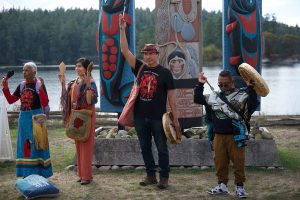
Photograph by Darrell Kirk