
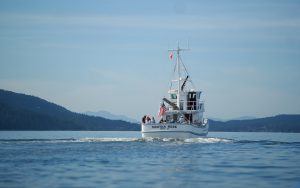

When borders divide, communities can choose to sail toward each other.
On a weekend in Sept. 2025, a flotilla of boats carrying roughly 100 Americans crossed the Salish Sea from Orcas Island, Washington, to Salt Spring Island, British Columbia—two islands separated by a national border but connected by tides, ferry routes, and the kind of neighborliness that doesn’t require a passport to feel.
The gathering was called Hands Across the Water, and it arrived at exactly the right moment, with tensions between the United States and Canada straining a friendship most people had taken for granted. A group of ordinary islanders decided the most powerful thing they could do was the simplest: cross the water and knock on the door.
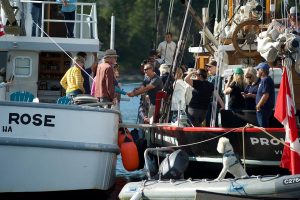
Photograph by Darrell Kirk
The idea began with a conversation about a pig.
When Orcas Island community advocate Ross Newport connected with Josiah French Feld of the W̱SÁNEĆ (Saanich) Nation, French Feld reframed the famous “Pig War,” long treated as charming Pacific Northwest history, as the moment a borderline severed indigenous families, forced communities onto reservations, and left a wound that was never fully healed. The event’s purpose shifted. This would not merely be a party. It would be a reckoning and a reconciliation.
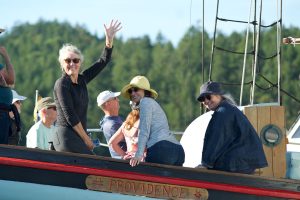
Photograph by Darrell Kirk
Organizer Natalie Zohar spent four months on Zoom, weaving together the Orcas Island Yacht Club, the Salt Spring Island Chamber of Commerce, and Transition Salt Spring into an improbable collaboration. Even the Canadian Border Services Agency called to offer help.
“They said, ‘We heard about it on the newsreels. We want to know how we can help,’” says Zohar. “They added staff at the Bedwell Harbour station and gave us a direct phone number.” The welcome was warmer than anyone had dared hope.
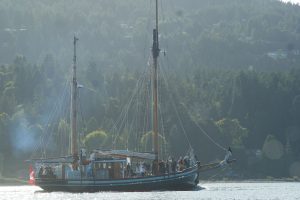
Photograph by Darrell Kirk
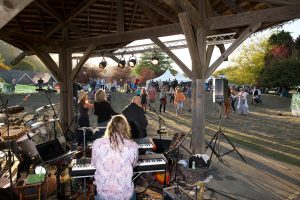
Over three days, Salt Spring rolled out something between a town fair and an ideas festival, featuring yoga, a Lions Club pancake breakfast, and a floating evening concert aboard the Providence. But the heart of the weekend was three community panels that brought both islands face-to-face with the challenges they quietly share.
The “Creating Affordable Housing for a Resilient Community” housing panel drew passionate exchanges. Lisa Byers, executive director of OPAL Community Land Trust on Orcas Island, laid out the stakes plainly.
“In 1989, it cost us $10,000 in subsidy per home to make it happen,” she said. “Today we’re about to deliver our 220th home, and it costs $380,000 in subsidy per home.” Salt Spring Islanders fighting identical pressures recognized every word.
Photograph by Darrell Kirk
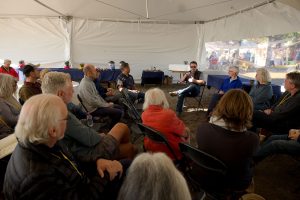
The “Protecting Our Shared Environment” marine panel pushed the conversation into the water itself. Cindy Ellister, associate director of the Salish Sea Institute at Western Washington University, was direct.
“This is one giant, connected ecosystem that we are managing separately, and that’s not smart.” Endangered southern resident killer whales swim freely across the international boundary only to encounter entirely different regulations on each side, a metaphor for the entire weekend.
Photograph by Darrell Kirk
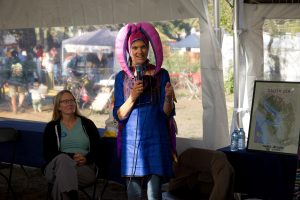
The “Regional Indigenous Issues and Knowledge Exchange” panel gave voice to the truth that the border through the Salish Sea had never been agreed to by the people who lived there first. Josiah French Feld, of the W̱SÁNEĆ (Saanich) Nation, joined by phone and spoke simply.
“These waters have always been a highway of connection. The border was made without our voices.”
Photograph by Darrell Kirk
The panel’s most extraordinary moment came when elder Nemetia, known in English as Jill Harris, Secretary of the Elders’ Council for the Penelakut (Puneluxutth) tribe, rose and addressed Josiah directly. She described how her grandmother had faithfully taken her father and aunt to shake hands with Josiah’s grandmother every year, though no one in the family ever knew why.
“My aunt didn’t know why she was made to do that,” she said. “But now I’m understanding why.” The room fell still as the realization rippled through it: the two were related. Years of genealogical research had confirmed it—her great-great- great-grandfather was born on Guemes Island in the San Juans. A kinship interrupted by a border, rediscovered at last.
Photograph by Darrell Kirk
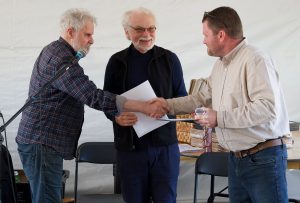
At the closing ceremony, San Juan County Councilman Justin Paulsen read a proclamation whose language carried unusual weight for a government document.
“We choose to become the best versions of ourselves as neighbors, as friends, as people moved by care and community reconciliation,” he read, “and we declare our intention to strengthen this cross-border friendship, to steer away from division, and sail toward the True North of unity and engagement.”
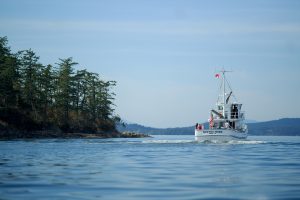
Photograph by Darrell Kirk
The Salt Spring Island Local Community Commission responded simply: “In a time of increased tensions between nations at the highest level, this event shows the power of ordinary citizens.”
The flotilla sailed home carrying plans already forming for a cross-island radio program, collaborative maps of the Salish Sea drawn without a border, and the germ of regular dances between the islands—just as, someone discovered over dinner, their grandparents had done a generation ago.


