


Since Time Immemorial is a recurring series featuring community members whose families have been here since time immemorial. The ancestral knowledge carried by Lhaq’temish, Nooksack, and other Coast Salish peoples is knowledge about how to live in our shared home in a good, life-sustaining way. We live in a time when we need to restore our relationship with Mother Earth and with one another. We are grateful for these stories, told in the words of each featured individual.
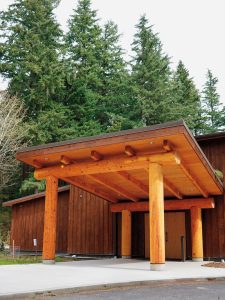
Photograph by Griffin Ritzo
Lhaq ’temish-ew’xw e tse XwLemi – House of Healing is a newly constructed longhouse for Native students and community at Western Washington University (WWU). Its name means “Building of the Lummi Who Are Descendants of One of the 44 Original Tribes,” and as such, acknowledges the traditional territory on which it’s built. The longhouse project stemmed from the 2016 Native American Student Union Red Letter, which outlined ways in which the urgent needs of Native students could best be met. Kyles Gemmel, Talia Natachu, and Michaela Vendiola along with numerous other Native students, staff, faculty, alumni, and community elders worked to realize this vision. Situated in a meadow amongst the trees of the Sehome Arboretum, close to the Fairhaven College campus, the longhouse features a grand kitchen, indoor and outdoor experiential learning sites, and gathering spaces. The longhouse will host inclusive, intergenerational events, including a speakers series and small coastal jams. It is slated to officially open in May 2026. Tribal Liaison Laural Ballew-Ses yehomia/tsi kuts bat soot (Swinomish) and WWU colleagues simone-calais staley (nimiipuu) and Grey Webster (Onöndowa’ga:’) have been lovingly working on the project for years, and here share some words and story.
Laural: The House of Healing longhouse is a home. It’s a place where our students, faculty, staff, surrounding community, can come and learn, share our Indigenous knowledge. It’s a place to gather and be as a family. You come and hear, Let me give you a cup of tea. Here, here’s a little bite to eat. Laughter is so important. Stories and laughter—that feels like home for me, for a lot of our students. This longhouse will be where we’re going to gather from all corners, doesn’t matter what tribe. Students can come and learn from each other, hold each other up, become stronger in mind and spirit. The longhouse is situated among the trees, with the ancestors. Spirit is really, really important.
Simone: There is something that feels spiritual about the site. Here’s a story: I used to manage the Fairhaven College Residence Hall, which is right down the street from the longhouse. Back in 2014, 2015, I used to walk my dog up and down that hillside, we would walk through the meadow that is now our longhouse site. It felt like home there even back then, it’s almost like the land was waiting for the longhouse. We recently planted Camas bulbs and they are responding as if they have always been there. It feels like the Camas is coming home and our students are coming home.
Laural: And I think for the university, the longhouse is an act of reciprocity, they’re giving back. At the groundbreaking, the President apologized to the Lummi Nation and for how students had been treated. That was huge, that was really putting meaning behind the land acknowledgement. This longhouse is about healing in many ways.
Simone: We also have a Healing Garden. In the future, we’ll harvest medicines and use the teaching kitchen to practice our ancestral ways. We have Cedar, Fir, and Cherry trees. Kinnikinick, which is used in a lot of ceremony. Bear Grass for future weaving projects. Salal. We’ve already identified a couple patches of Snowberry that we can harvest for soap making. We’re planning for Sweetgrass, Tobacco. We’re going to make sure all of our traditional medicines are there, and also fruits, berries, produce, so students can learn how to grow food as well as how to prepare and preserve foods. The healing garden is a project that can heal our peoples, heal our bodies and heal our minds, getting our hands dirty in the soil, and celebrating together when we have a harvest.
Grey: There are so many parts to this healing garden. The first healing is for us as human relatives, connecting people back to plant medicines and foods and lifeways that they have lost or temporarily don’t have because they’re living hundreds or thousands of miles from home. Another healing is of the animals and plants themselves. We’re bringing back plants that were here since time immemorial but were removed over the last 100, 150 or so years. Bringing back these plants will allow the deer, the birds, the bugs, the worms, our animal relations to return and find their foods here.
Simone mentioned Camas, a traditional food. Here’s a story. Some of our Camas here came from plants originally cultivated by WWU professors. They wanted to see if they could get different colors of flower by selecting and crossbreeding phenotypes. This experiment on our plant relative wasn’t necessary, and projects like this diminish the importance of this sacred food source. When those professors left, the patch of Camas was ignored for years. Eventually, that site was going to be bulldozed and those plant lives would be lost and meaningless. Some Native professors and their allies relocated those plants and started tending them, returning them to how they should be. We’ve planted seeds from some of those saved plants. It feels like the Camas, having survived experimentation, now has a purpose and will teach so many generations.
Simone: Yes, it felt good to honor our plant relative in a way that it hadn’t been honored institutionally. Camas is cherished across Turtle Island, it’s something that is passed down to us by our mothers, but in this story it was seen as something to be used for experimentation. Which I feel is really representative of what higher education has done to a lot of Indigenous peoples. Returning the Camas to this field, now it’s being tended to, it’s being prayed over. It’s being given Tobacco and being given reverence again, it’s being touched by loving hands. We’re healing the Camas, and we’re also healing ourselves.
Laural: Who better to learn healing from than the Native people of this land who have been through hundreds of years of invasion and disease and boarding school relocation? Everything that has been thrown at us by the federal government to eradicate us. We’re still here. We’ve grown stronger. And you know, we’re willing to share that knowledge to anyone who wants to come in and learn.
Julie Trimingham
Julie Trimingham is a mother, writer, and non-tribal member of the Sacred Lands Conservancy (SacredSea.org), a Lhaq’temish-led non-profit dedicated to protecting Native sovereignty, treaty rights, sacred sites, and the life and waters of Xw’ullemy (the Salish Sea bioregion). Her heart is filled by the work to protect and promote ancestral place-based knowledge so that we can all learn to live here, with one another, and with Mother Earth, in a good way.


