


Since Time Immemorial is a recurring series featuring community members whose families have been here since time immemorial. The ancestral knowledge carried by Lhaq’temish, Nooksack, and other Coast Salish peoples is knowledge about how to live in our shared home in a good, life-sustaining way. We live in a time when we need to restore our relationship with Mother Earth and with one another. We are grateful for these stories, told in the words of each featured individual.
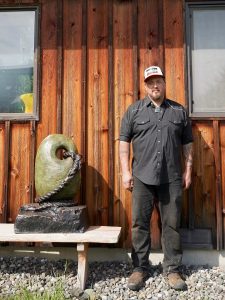
Photograph by Griffin Ritzo
Kwul Kwul Tw Dan Friday is an internationally acclaimed glass artist who also works in wood, metal, and stone. He studied at Pilchuk Glass School and apprenticed with Dale Chihuly, Preston Singletary, and Paul Marioni. Salmon, reefnet anchors, story poles, and other Coast Salish, Lhaq’temish, and Xwlemi stories and motifs appear in Dan’s work, as he is a citizen of Lummi Nation. He has exhibited and taught widely, and is currently building a hot shop (glass studio) in Skagit County. Some of his work can be seen at fridayglass.com.
What was your path to making art?
Well, there’s a long history of artists and artisans in our family. My Indian name is Kwul Kwul Tw, spirit of the war club. It’s my great-grandfather’s name, Joe Hillaire, who was a story pole carver. Some of my first memories are with my grandma Dot; we’d make things with clay, little snowmen, little baskets, nothing jaw dropping.
And I grew up without a TV. At the time, I felt like, Mom, you failed. We’re so poor, we can’t even afford a TV. This is like some sort of torture I’m growing up in, but now, in hindsight, I feel like that’s definitely correlated to why I’m an artist and work with my hands. Without TV, you need to entertain yourself and go outside.
When I was 11, getting thrown out of the classroom, Jerry Satterlee, the principal at the school, he’s like, Come to the ceramic studio. He gave me a place to go and make stuff. He also took me by a glass blowing studio. I immediately loved it, but it seemed so unattainable, like a rich kid hobby. Later, when I was 20 and driving a tow truck, training to be a repo man, I got a job at a glass factory sweeping floors and charging the furnaces, which means filling the furnaces with glass. As soon as I saw glass, I was like, “This is absolutely what you’re doing at all costs. You’ve got to quit drinking. You’ve got to change your life, dude, no more fighting on the weekend or whatever.” So I dropped doing all this stupid stuff I’d been doing and committed to doing glass. And then later, when I was going through a hard time, questioning myself, Aunt Fran—Fran James, who has her basket work in the Smithsonian and was mother to the late Chief—she really gave me a kick in the pants to keep going on with my art.
Why glass?
Glass is the most amazing material. Like this video call we’re having right now doesn’t happen without glass. Your phone screen, every light bulb, every photograph you’ve ever seen doesn’t happen. Lenses—our ability to view stars in the sky and to look down to the molecular level—all these things are possible because of glass.
Glass is really fragile, that’s what makes it so precious. You have to treat it with respect, or it just breaks. But then also, it lasts for thousands of years. One of my favorite pieces is at the Corning Museum of Glass. It’s a bust of Akhenaten and it’s 3400 years old. Some artist was representing the deity, the pharaoh, somebody was telling a story in this really permanent, precious, difficult medium.
It’s just mesmerizing. Like even a piece of beach glass has this gem-like quality to it. People are like, Why does it cost so much money? I’m like, It costs so much money to make it. It’s an amazingly resource-heavy thing. We’re talking about gas, electricity, materials. Sometimes we are literally melting gold.
Is glass basically melted sand?
Or soda lime, calcium, silica. But yes, it is just sand. Glass was probably first formed in the bottom of a fire pit somewhere, or by lightning strikes, some place where things get hot enough to melt sand. Technically, glass acts like a slow-moving liquid that’s frozen at room temperature. It starts to move at about 1000 degrees Fahrenheit.
Do you ever get burned?
All the time.
The whole process seems super labor intensive, complex, and maybe even dangerous.
Glass blowing is like a fire drill. You show up in the morning and you have to have your team coordinated. You’ve got to have your color laid out. Slouches don’t last, there’s just not a place for you if you aren’t willing to work hard.
When the glass is hot, it just moves. I usually have at least two assistants. We divvy up the tasks among the team. There’s actually less blowing than you think for something called glass blowing. I do a lot of sculpting, I cut and poke and trim. It’s a lot like couples dancing, you know, you’re trying not to step on each other’s toes. Part of the flow state of glass making is how we work as a team.
I’ve heard it called a sit-beside art. Like, do you want to learn how to weave a basket? Will you sit next to Aunt Fran and you help her get her stuff ready? There’s a lot of that old world apprentice history in glass making that I really like. A couple of the guys on my team have been working with me for 15, 20 years. I always encourage the people working for me to get out and do their own work, like my mentors held the door open for me. I love the people that I work with. The community is what draws a lot of people. I mean, we’re all looking for our people and family.
Hy’shqe, Dan!
Julie Trimingham
Julie Trimingham is a mother, writer, and non-tribal member of the Sacred Lands Conservancy (SacredSea.org), a Lhaq’temish-led non-profit dedicated to protecting Native sovereignty, treaty rights, sacred sites, and the life and waters of Xw’ullemy (the Salish Sea bioregion). Her heart is filled by the work to protect and promote ancestral place-based knowledge so that we can all learn to live here, with one another, and with Mother Earth, in a good way. julietrimingham.com, @Juliet7Seven


