
Editor’s note: This story originally ran with Michelle Schraeder’s last name misspelled as “Schrader.” It has been updated here. Our deepest apologies for this inaccuracy.
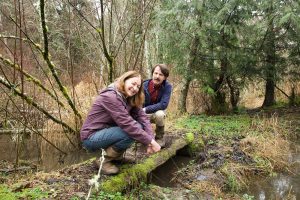
On a quiet stretch of land near Everson, where Ten Mile Creek winds through marshland and meadow, Ed Stone kneels beside a spring-fed channel surrounded by canary grass, the invasive species that once hid dozens of natural springs. Decades of patient restoration show in every clear, cold trickle. The water flows year-round here, even in August’s dry heat—a testament to the springs Ed uncovered by hand, shoveling through silt and canary grass to reveal what had been hidden for generations.
Ed and his wife Michelle Schraeder grew up worlds apart—he on a Virginia farm bordered by National Forest, she in suburban New Jersey. But when they moved to this property in 1987, they found common ground in an unlikely vision: to restore the degraded farmland back to what it might have looked like two centuries ago, before settlement transformed it into pasture.
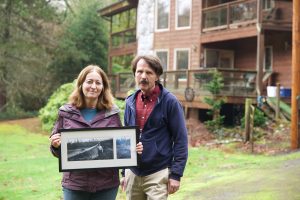
Michelle Schraeder and Ed Stone | Photograph by Darrell Kirk
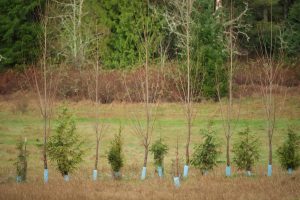
“She [the real estate agent] was standing in the creek, and you couldn’t even tell it was there because of the canary grass,” Ed recalls. The entire streambed was choked with invasive canary grass, the water invisible beneath dense vegetation. After buying the 25-acre property—drawn by Ed’s childhood memories of creek life—he started with a rake, pulling grass by hand. Someone from the Whatcom Conservation District gave him crucial advice: canary grass hates shade. Plant trees.
Photograph by Darrell Kirk
What began as weekend work evolved into a decades-long partnership with conservation organizations. The Whatcom Conservation District helped them excavate wildlife ponds in 1989. The Nooksack Salmon Enhancement Association assisted with in-stream restoration projects. And as the couple acquired neighboring parcels—eventually growing their holdings to 82 acres—they turned to Whatcom Land Trust to ensure their work would outlast them.
“Michelle and I realized that once we are gone, there’s not going to be anybody here to take care of this property,” Ed explains. Through conservation easements with the Land Trust, they’ve removed all but two development rights from the property, protecting it in perpetuity.
Photograph by Darrell Kirk
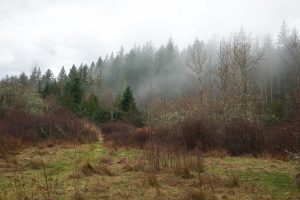
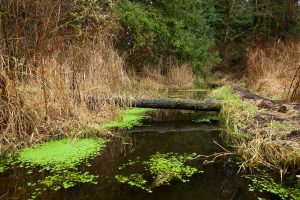
The transformation has been remarkable. Where canary grass once dominated, native trees now create shaded corridors. Spring-fed channels that Ed dug out by hand flow clear and cold, maintaining consistent temperatures around 55 degrees year-round. Most significantly, salmon have returned. Coho now spawn in gravel beds that didn’t exist when Ed and Michelle arrived, their fry maturing in the ponds before heading to the ocean.
“If you restore it, they will return,” Ed says, his mantra during countless hours of trail-building and tree-planting. One year after floods in 2021, they counted 19 salmon in a single tributary, the most they’ve ever seen.
Photograph by Darrell Kirk
The couple’s commitment extends beyond physical restoration. Ed, a veterinarian who bought his practice in 1986, spends evenings after work on the land—not as labor, but as stress relief and joy. Michelle, also a veterinarian at the same practice, shares his vision of the property becoming an educational resource. They envision field trips, research projects, and camps for young naturalists learning about salmon recovery and ecosystem restoration.
“We want it for education and research,” Michelle emphasizes. “Not another park.” They’ve already hosted groups through the Nooksack Salmon Enhancement Association’s education programs, where children as young as 6 participate in hands-on learning about salmon.
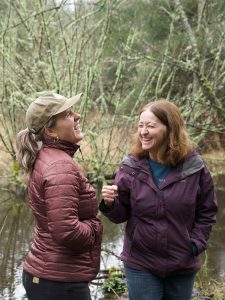
Claire Johnston, Communications Director at Whatcom Land Trust, with Michelle Schraeder | Photograph by Darrell Kirk
Claire Johnston, the Whatcom Land Trust’s communications director, marvels at what they’ve accomplished.
“It’s incredible to see the amount of salmon habitat you’ve recovered,” she says to them, walking the property’s winding trails. “So much room for the stream to meander and create areas with good gravel for spawning and slow-moving water.”
Photograph by Darrell Kirk
Their advice for other landowners considering conservation easements is practical and heartfelt.
“Contact the Whatcom Land Trust,” Ed urges. The easements are customized to each property and owner, allowing activities like hazard tree removal and trail maintenance while protecting core conservation values. There are tax benefits, too—development rights can be written off over three years.
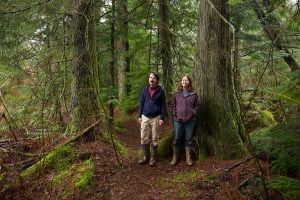
Photograph by Darrell Kirk
As Ed walks the Marsh Trail, beaver dams visible downstream, it’s clear this work has become something larger than either partner initially imagined. What started as a simple desire for land with a creek has evolved into a living laboratory for restoration ecology, a refuge for wildlife from river otters to mountain lions, and a legacy that will serve the community for generations.
“We’ve seen what has happened over the past 20 years here on this property and how much it has returned to a place where wildlife can live and where salmon can spawn,” Michelle reflects, looking back at the work that began with a simple rake and a vision of restoration. Everson, whatcomlandtrust.org