Since Time Immemorial is a recurring series featuring community members whose families have been here since time immemorial. The ancestral knowledge carried by Lhaq’temish, Nooksack, and other Coast Salish peoples is knowledge about how to live in our shared home in a good, life-sustaining way. We live in a time when we need to restore our relationship with Mother Earth and with one another. We are grateful for these stories, told in the words of each featured individual.
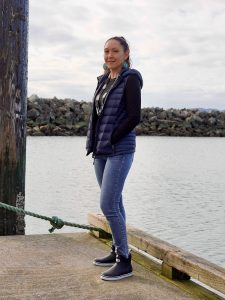
Sunshine Fitzgibbon | Photograph by Griffin Ritzo
Esitenaut Sunshine Fitzgibbon is a mother of three, a wife, and a fisherwoman. She worked for Lummi Nation in Human Resources for over 20 years, taught at Northwest Indian College for seven years, and is now the Water Rights Adjudication Coordinator for Lummi Nation. In 2023, after celebrating her daughter’s quinceañera, Sunshine and her sister Angel saw an opportunity to create memorable photo experiences for other families, so they launched Moonlit Photo Booth LLC, which serves events throughout Whatcom and Skagit Counties. Sunshine also loves to keep her hands busy by crafting earrings from beads, clay, and resin.
Sunshine, I recently saw a great picture of you hauling up a crab pot. What’s your relationship to fishing?
I’m a lifelong fisherwoman. I come from a fishing family. My father has owned and operated numerous fishing vessels. My mother had her own boats as well, she was a very strong fisher woman. My father speaks proudly of my mother and how at times she caught more than him. I was fortunate enough to grow up in a time when the fish were more bountiful. Instead of openings that were hours long, they were months long. My parents fished and crabbed and shrimped here in the Salish Sea. Every summer we went to Kenai, Alaska to fish. In the fall we’d go to California and fish herring in San Francisco and Sacramento. We were always following the fish. Growing up we had no technology, just fish plungers and watching for the fish jump. My sisters and I would help pick fish when we were old enough, but before we could do that, we’d help pick seaweed out of the net, play with jellyfish, watch for porpoises and orcas. That was our life and our entertainment. We would sleep on the boat for weeks at a time. We could only shower when we’d go to Point Roberts with our quarters to take a cold shower and wash the fish scales out of our hair.
And you’re still at it.
My sister and I go crabbing together. My oldest son and some of my nieces and nephews go out crabbing with my dad. And when it’s time for shrimping, we all do that together. My dad had the first tribal permit to shrimp in our waters. Fishing has always been a family thing that we all do together. The Salish Sea runs through our veins.
Even though the openings got shorter, and we couldn’t rely on an income from fishing, it’s a way of life. Like Ellie [Kinley] says, it’s called fishing and not catching. We go out there because we love it, it’s how we grew up. It’s where I feel most at home. It’s where I feel closest to my mother, who’s passed on. I know she’s right there with us. I do it to be connected to who we are as Lhaq’temish people, water people, salmon people.
And now you’re working to protect salmon with the water adjudication process. Can you speak a bit about that?
Well, salmon need water. They need a healthy and productive habitat. They need clean water and they need enough water to be able to swim up and down their creeks and tributaries. There’s too much water being drawn from the Nooksack River and now the water levels in the streams are critically low. The salmon can’t come up and down the waterways as they should. For decades, the salmon runs have been in crisis, and it all goes back to habitat that’s degraded or inaccessible.
The first step in the adjudication process is documenting and quantifying legal water usage, everything from residential to commercial to industrial development. As Lhaq’temish people who have been here since time immemorial, our right to the water we need is guaranteed. We are also taking on the responsibility of quantifying the needs of and filing claims for the salmon, for each stream and tributary where the different species swim up and down.
You’re filing claims for the salmon as well as for people?
Well, we are salmon people. Salmon have always been a part of who we are. They’re interwoven in all aspects of our history, our tradition, our culture. You really can’t separate Indigenous people of this area from salmon. You can’t separate us from the lands and the waters. We’re one and the same. We’ve always relied on the salmon, protected the salmon, fought for the salmon.
What are you hoping the outcome of all this adjudication process will be?
I hope and pray that in the future we’ll have a healthy salmon population and that we’ll responsibly manage it. I hope and pray that my children are able to practice our traditional way of life, fishing and shrimping and crabbing. That they get to experience openings that are months long instead of hours. All of us who live on and by the Salish Sea need to work together, we’re all stewards of this land and the waters. We need to work together and we need to work with nature to ensure healthy water quality, healthy water levels, healthy salmon runs. We need to work towards a healthy ecosystem that salmon, orcas, humans, we’re all a part of. We need to find a balance and a way forward. We need to work with Mother Nature, because without that, we literally have nothing. All of us are lost without healthy waters. Water is life!
Julie Trimingham
Julie Trimingham is a mother, writer, and non-tribal member of the Sacred Lands Conservancy (SacredSea.org), a Lhaq’temish-led non-profit dedicated to protecting Native sovereignty, treaty rights, sacred sites, and the life and waters of Xw’ullemy (the Salish Sea bioregion). Her heart is filled by the work to protect and promote ancestral place-based knowledge so that we can all learn to live here, with one another, and with Mother Earth, in a good way.