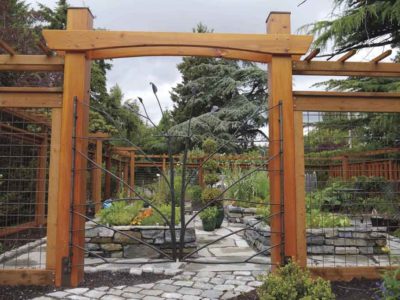
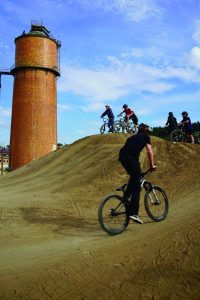
On any given day in Bellingham, a group of riders is gearing up to roll out, weaving through faded green bike lanes and disappearing into the verdant forest of the Hundred Acre Wood.
Whether cycling at the edge of a downhill run or pedaling past a downtown bike shop, it’s inevitable that riders will be pulled into a conversation about where to ride next. Bikes have become a defining part of Bellingham’s identity, and these sorts of interactions are not unusual. Rather, they are an integral part of a devoted and constantly growing culture built around cycling. What that culture means depends on who you ask.
“One thing I love about the bike culture here is that who you are matters more than how well you ride. The level is high, but the pressure is low. No one invites you on a ride because they think they are better than you. People just want to have fun and be good to each other,” says Isaiah, an employee at Fanatik Bike Co. and a member of the Western Washington University Mountain Bike Club.
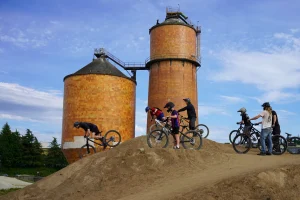
The idea that identity matters more than skill is part of why people love biking here. Openness and connection are major players in the social element of Bellingham’s cycling scene, as they help form how the culture feels.
“It’s extremely welcoming. You can go out on the trails and immediately meet people who will tell you where to ride. Sometimes it’s almost too much. Someone will have a small issue with their bike, and suddenly, five people are giving advice. But it comes from a good place,” says Isaiah.
Bellingham is a tight-knit small city that appreciates and protects the accessibility of its outdoor spaces, allowing it to flourish as a year-round bike-friendly haven. However you ride, it doesn’t take long to find your tribe around town.
Inclusivity is deeply ingrained in Bellingham’s bike culture, though it has long existed alongside a kind of split identity between trail riders and everyday cyclists. For years, there was a clear separation between mountain bikers and those who rode to commute or get around town. Recently, that divide has begun to blur. As mountain biking has grown in popularity, the overlap between these groups has become more visible, and the culture has expanded.
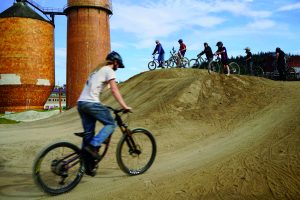
Nowadays, there are more social riding groups than ever, thanks to public platforms like Smart Trips and Bike and Roll Bellingham that encourage social connection and civic engagement. Additionally, efforts toward championing a more welcoming cycling community are especially visible in the rise of women-centered and gender non-conforming groups, such as JoyRiders and Shifting Gears, which aim to create space within what has traditionally been a male-dominated sport. As the scene has expanded, advocacy groups like Walk and Roll Bellingham and Whatcom Mountain Bike Coalition continue to push for improved infrastructure and incentive programs, encouraging more people to adopt cycling as a sustainable form of transportation.
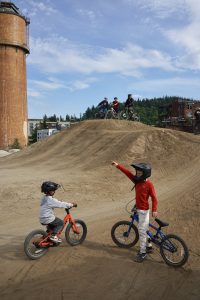
Access for young riders has also increased. Where mountain biking once relied largely on parents to introduce kids to the sport, there are now structured summer camps and school-connected programs that bring younger riders in. Organizations like Vamos Outdoors play a key role in widening access to mountain terrain biking, helping break down financial and cultural barriers in a sport that has historically been both expensive and exclusionary.
Cycling in Bellingham is shaped as much by economics as it is by these community outreach efforts. As gas prices and everyday costs rise, more residents are trading in their car keys for a three-speed. That shift is reflected in the mission of Bellingham’s The Hub Community Bike Shop.
“We try to encourage reuse and repair instead of constant consumption. People come in, work on bikes, talk, and learn. That part is just as important as anything we sell,” says the shop’s Executive Director, Kyle Morris.
Founded in 2002, The Hub operates as a non-profit resource space, where bikes are repaired and redistributed to those who need them most. One of the shop’s most prominent education and service programs is Trash Club, a monthly bike-powered land stewardship meet-up, which has successfully helped remove over 75 tons of trash from Whatcom Creek since July 2021.
This is just one example of how cycling in Bellingham extends far beyond the bike itself. Around here, bicycles exist as a shared form of community that ceaselessly reflects the collaborative, outdoors-oriented spirit that has long defined the city and what it means to be a Bellinghamster.
Get to Know Bellingham by Bike
Written by Sarah Burch
A new program fills a gap in Bellingham’s cycling culture. It provides self-guided tours that foster discovery and connection to community. The premise is this: the more someone learns about a place, the more they will feel connected to that place. BIKE Bellingham provides themed ride guides that connect cyclists with Bellingham’s culture, heritage, landscapes, and businesses. The guides which include maps, navigation, and descriptions of stops along the way; provide structured itineraries that have been curated to highlight the best sites, scenery, and establishments. Cyclists choose a theme that tickles their fancy, download the guide to their phone, and then pedal the route at their own convenience and pace.
One of the popular rides, “Treemendous Trees,” takes cyclists to see 15 tree-themed places that tell stories about ecology, history, and local tree heroes. The guides feature tree-themed businesses and provide information about the city’s tree initiatives and tree-related organizations in town.
BIKE Bellingham was developed by Sarah Burch, who spent more than a decade as a full-time nomad traveling predominantly by bicycle. When she settled in Bellingham, she applied her passion for exploration to her new world, a place smaller than 30 square miles. She created BIKE Bellingham to help cyclists feel a sense of discovery in their own community. Burch hopes that the rides will help cyclists fall more deeply in love with where they live and recreate.
The rides are comfortable for casual cyclists and are offered free of charge. Visit bikebellingham.com to learn more.
Photograph by Griffin Ritzo (PC) and Photograph courtesy of Vamos Outdoors Project / Shifting Gears (CO)