
In an unassuming building downtown, there’s a tireless effort taking place daily on behalf of our region’s most vulnerable children.
“I just can’t believe how many people don’t know what exists in this building,” says Kaelen Grimes, director of development and communications at the Brigid Collins Children’s Advocacy Center (CAC). She reached out to offer me a tour of the Bellingham center, to help spread the word within our community—not only about the important work they do, but about the resources they offer. “Hopefully you never need to use this service, but if you do, knowing it’s here [is the first step].”
Photograph by Griffin Ritzo
The Brigid Collins Family Support Center, of which the CAC is a part, has been serving families in Bellingham since their founding in 1990 by a “core group of volunteers who had a hope of better coordinating the community’s response to child sexual abuse.” Since then, they’ve expanded to support the communities of greater Whatcom, Skagit, and Island Counties, offering a range of programs aimed at preventing abuse, facilitating intervention, and mitigating the harm it causes.
The cornerstone of their mission, “to strengthen community health and resilience by providing comprehensive support to children and their families,” is the Children’s Advocacy Center. There are two locations, one each in Whatcom and Skagit, where all the necessary and disparate local agencies can coordinate their approach to accusations of abuse.
Photograph by Griffin Ritzo
“This is where a child who has disclosed abuse or neglect of a severe and sexual nature would have a child forensic interview,” Grimes says, her clarity and professionalism honed over years of speaking about such a difficult subject. “The purpose of the center is so that the child does not have to retell their story over and over and over, because it’s retraumatizing.”
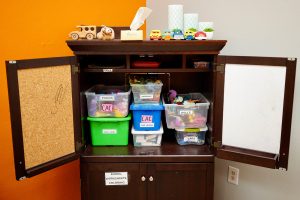
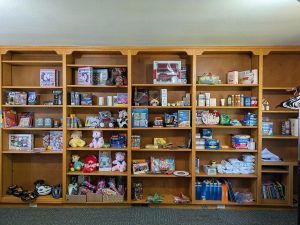
Grimes shows me around the center, starting at the room the team refers to as “BC Maxx,” which is stocked with diapers, sanitary products, handmade quilts, toys and games, and other daily essentials, hygiene items, and comfort items that can’t be procured with state or federal assistance programs. From there, we head downstairs to see the interview room, family area, and medical examination room—every inch of the space has been set up with the child’s safety and comfort in mind, as well as compassion for any family members who may have accompanied them, including siblings who may be afraid or bored.
Photograph by Anne Godenham
“We are constantly trying to improve this space,” she says, gesturing around the cozy family room where children and guardians meet with their case managers. “We fundraise from private donors and local service clubs to be able to purchase furniture and make updates to the space.”
While the interview room itself is intentionally bare, to avoid triggers and distractions for the child being interviewed, it is comfortable and the two-way mirror and camera are clearly visible. On the other side of the mirror, a multidisciplinary team observes the interview, which is also recorded—the recording is directly uploaded to evidence.com, enabling access by law enforcement and legal staff. This hopefully lessens the need for directly involving the child in any further legal process and leads to an arrest.
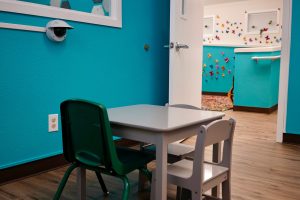
Photograph by Griffin Ritzo
“If this does what it’s supposed to do, someone leaves this room and makes an arrest,” Grimes says. The ultimate purpose of the interview is: “something’s disclosed…that triggers law enforcement to be able to leave here and directly remove that person from access to this child.”
It’s a heavy subject, and more than once during the tour I catch myself grimacing, my heart aching as a mother. But it’s also extremely heartening to see all the work and energy and thought that’s put into supporting these kids and their families.
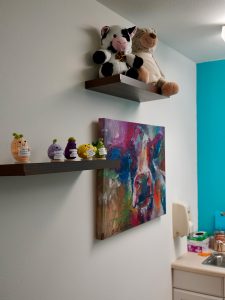
Photograph by Griffin Ritzo
“In our region, there were over 4000 cases of found child abuse—over 2000 of those are from Whatcom County alone—in 2021,” Grimes says, nodding somberly at my stunned repetition of “found” under my breath. “That’s about as many babies as are born in Whatcom County [in a year].”
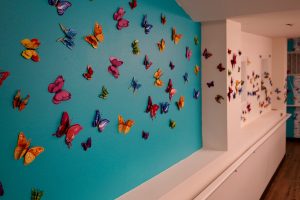
While those numbers are undeniably devastating, the team at the CAC has chosen to measure their ongoing support for these children with a visual representation that’s equally impactful. The hallway outside the sparse interview room is a riot of brightly-colored butterflies—each chosen by a child who’s been interviewed since 2020.
“It’s…meant to signify that there is hope from something that can be very challenging, and change can be a good thing,” Grimes says. “These kids are coming in here to do probably the scariest thing they’ve done in their young life…when they leave, [we want them to] know that the best thing they did for themselves was speak up.”
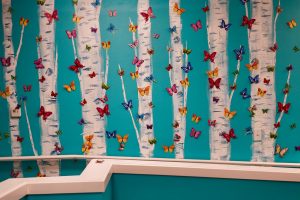
Photograph by Griffin Ritzo
And it’s not just about the children these kids are now, but also the adults they’ll become, and the community they’ll be part of. As Grimes points out, “if you don’t address childhood trauma, it shows up in an adult’s adverse life experiences, which our community is feeling the weight of currently.” Treating childhood trauma early is one crucial way that the Brigid Collins Family Support Center is working to help the entire community, from children to adults.
I went to the CAC with little idea of what to expect, but I left completely blown away by the level of support the center provides to these families and the dedication and passion shown by Grimes and her colleagues. Unassuming as the building may look, what’s happening inside is nothing short of inspirational. 1231 N. Garden St., Ste. 200, Bellingham, 360.734.4616, brigidcollins.org