Since Time Immemorial is a recurring series featuring community members whose families have been here since time immemorial. The ancestral knowledge carried by Lhaq’temish (Lummi), Nooksack, and other Coast Salish peoples is knowledge about how to live in our shared home in a good, life-sustaining way. We live in a time when we need to restore our relationship with Mother Earth and with one another. We are grateful for these stories, told in the words of each featured individual.
Joshua Hillaire of Lummi Nation is a father, a fisherman, and part of Setting Sun Circle, which is the latest incarnation of a multi-generational vision to, broadly speaking, keep alive traditional Lhaq’temish teachings and way of life. Formerly known as Children of the Setting Sun Productions, Setting Sun Circle is building its location in downtown Bellingham and has expanded its mission to be “an Indigenous-led nonprofit organization that weaves together storytelling, education, and research to amplify Native voices and inspire collective action to protect Mother Earth.” During our conversation at a picnic table by the seiner gate at Squalicum Harbor, Joshua’s six-year-old daughter presented him with a rock, a feather, and a tiny, found paintbrush.
I always ask people to please introduce themselves in whatever way they’d like.
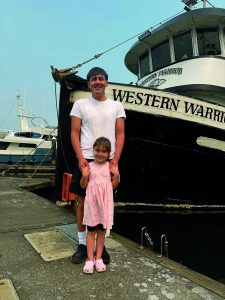
Hello, my name is Joshua Hillaire. I come from the Hillaire family and the Kinley family and the Wilson family. On my mother’s side, it’s Tahnee Kawakone, and then it goes Darrell Hillaire and Julia Ortiz. And on my father’s side, it’s Rick Kinley, Jr. and his father is Rick Kinley, Sr. and his mother is Heather Wilson. And then with the addition on my mother’s side, I have Derek Kawakone. I’m a member of the Lummi Nation.
Thank you. I appreciate how often I hear people introducing themselves in relation to their family, where they come from. A person is themself and always part of something bigger. I’m wondering if you might share with us a bit about how you spend your days?
Well, I’m a full-time father, and then I’m also fishing on one grandfather’s boat and I’m working with my other grandfather (Darrell Hillaire) at the Setting Sun Circle. At Setting Sun, we come from Hae’tel’luk, and his teaching was always to keep the fires burning.
What do you mean by “keep the fires burning”?
Keeping the fires burning can mean a couple things. The way that I was taught was we’re keeping our stories and way of life alive. As I’ve gotten older, I’ve started thinking about a campfire. It’s keeping the stories alive and it’s also bringing people together. People sitting around that campfire, you know, the fire giving some light and warmth. It’s a place where people can come and feel safe and loved and comfortable. I guess what shaped that interpretation was one of my great grandfathers. He used to tell me, A little love goes a long way. Everywhere you go, you go into it with love in your heart, and you don’t let the outside world really affect it. You just go into it with love.
That’s lovely. So what is it that you do at Setting Sun?
Right now, I’m shadowing my grandfather, learning as much as I can about our family’s history and about the business of Setting Sun, how it works.
Because you all have so much in the works these days! A huge new building project, so many people and moving parts—films, podcasts, visual arts, a library, gatherings, research. And this is all connected to your family history?
My third great grandfather’s name was Frank Hillaire. Hae’tel’luk was his Indian name. He was the one that instilled the teaching of keeping the fires burning. He created a dance group called Setting Sun. That’s where it all started, from Frank Hillaire. Then it was passed down to his kid Joe Hillaire, who did a lot of storytelling through totem poles, and also had the dancers; he kept the fires burning. He loved people, helped people with finding their identity, ’cause that’s kind of what this is all about, remembering who we are. Now it’s been passed down to my grandpa Darrell.
What kinds of projects is Setting Sun doing right now?
We’re creating an Indigenous hub where we can bring people in and share songs, share dances, share stories, and share food. Contemporary art. We’ll have an immersive screen for immersive experiences. We’ll welcome everyone, not just Indigenous people. We want everyone to come together, to come around the fire.
Why does this all feel so important?
When I was younger, I was very fortunate to travel around to Indigenous leadership conferences, youth leadership conferences. Almost always, a teaching that any leader from any reservation would pass down was about the seven generations. There are a few ways of looking at that, like, we look seven generations back to learn from them, or we look seven generations into the future to make sure we’re caring for them. Or, you can count the seven generations by saying you learn the teachings from three generations back, you live in the present, and you act for the benefit of the next three generations.
Like my granddad Darrell, he’s done so much. And he’s never done it for himself; it’s always for the next generation, you know? That’s what he always instills in us. We’re not doing this for us. We’re doing it for her [he motions to Daughter, who is painting the earth with a small paintbrush she found there], you know? Doing it for the next ones. Giving them a space to feel comfortable and safe to be who they are. And to give them a good world.
Hy’shqe, Joshua.