
Clashing swords, roasting turkey legs, magical creatures, and royals holding court. Where can you find all these things in the 21st century? At a renaissance faire, of course!
Earlier this summer, Skagit County hosted its first full-weekend renaissance faire, a novel event called Faire du Well. Organized by the Washington Shakespearean Festival (WSF), it took over Skagit County Fairgrounds from June 13–14, much to the excitement of local ren faire fans.
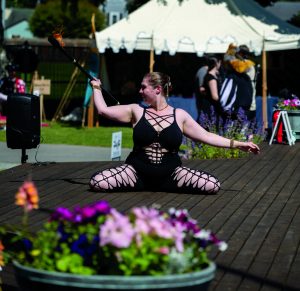
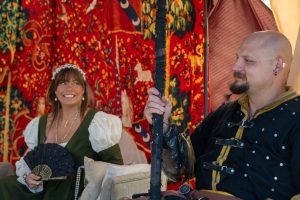
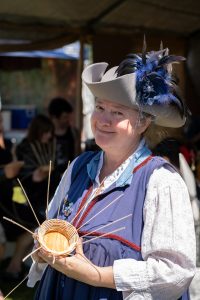
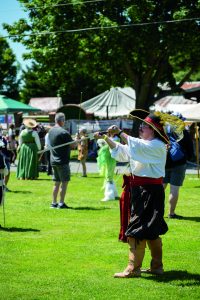
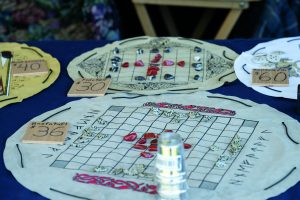
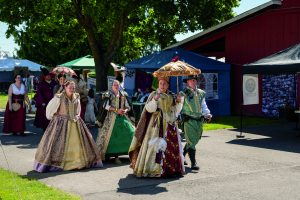
The faire featured a large market of local and regional sellers, traditional craftspeople eager to demonstrate to passersby, an “Exit, Pursued by a Beer” beer garden, and tons of wandering and staged performances. Bellingham’s 5CC Wrestling put on Shakespeare-inspired wrestling matches. Historical reenactors such as Mary Queen of Scots and her court via The Gilded Thistle and the Empire of Medieval Pursuits Duchy of Stormhold brought authentic wonder.
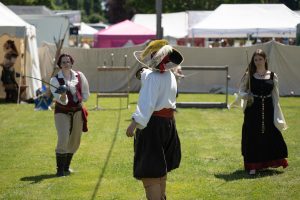
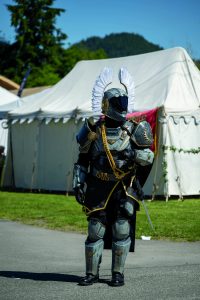
All these experiences and more were largely organized by the founder and managing director of the WSF, GregRobin Smith. Smith is a seemingly indefatigable performer, composer, sonneteer, scholar, and educator. The WSF is a nonprofit organization that offers “a variety of variety” services, including educational experiences, Shakespeare performances, ren faire acts (Smith becomes Robyn Plaeyr, The MayPole Man), and much more, with a company of about 20 regional performers. Notably, Smith is also a celebrated Benjamin Franklin performer. He steps completely into the role through an immersive acting method known as Chautauqua, and performs for classrooms, fundraisers, lectures, and parties.
Smith has been working at ren faires since the ‘80s, and founded the WSF back in the early 2000s with the goal of “supporting culture, education, and community through historical arts.” Faire du Well was, in part, inspired by the awakening and engaging effect immersive historical events can have on people.
“What I would see is people coming and engaging and leaving with a bit of realistic fantasy,” Smith says, recounting an example of someone dressing up as a knight. “People bow to them, they do mock battle, and they get to wear real armor for a while, and it’s like it changes their awareness.”
Taking everything he’d learned from over four decades of ren faire experience, Smith ensured that Faire du Well would be welcoming to all, which is part of why he chose Skagit County Fairgrounds as a location. Their manicured lawns, paved pathways, and ADA bathrooms and showers increase accessibility. This is just one step in Smith’s long-term plan. Smith hopes to hold Faire du Well at the Skagit County Fairgrounds for at least the next four years. Eventually, he aims to create a complete, permanent live-in Elizabethan village in Skagit, a hub for Shakespeare performances, renaissance faires, living-history experiences, and artists of all sorts.
“To understand Shakespeare is more than just, ‘This is the line, this is what it means,’” says Smith. “To understand Shakespeare in context, that’s why I want to build the village. Because [then], you’re not coming into a theater to see Shakespeare. You’re coming into a village, wandering around, seeing people in armor…dancing, and all this stuff, and then you’re going into the play, and the theater becomes an extension of that experience.”
Photograph by Pete Mitchell