

Since Time Immemorial is a recurring series featuring community members whose families have been here since time immemorial. The ancestral knowledge carried by Lhaq’temish (Lummi), Nooksack, and other Coast Salish peoples is knowledge about how to live in our shared home in a good, life-sustaining way. We live in a time when we need to restore our relationship with Mother Earth and with one another. We are grateful for these stories, told in the words of each featured individual.
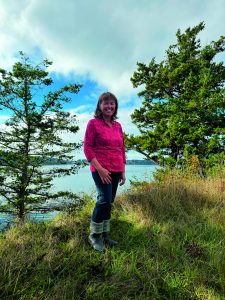
Tah-Mahs Ellie Kinley is a commercial fisherman and Lummi tribal member. She comes from the Solomon family, and married into the Kinley family. She serves on the Lummi Nation Fisheries and Natural Resources Commission, and worked at the Nation’s Sovereignty and Treaty Protection Office both during the years of the fight to protect Xwe’chi’eXen/Cherry Point from the proposed coal port, and then again when the Nation was working to protect the Southern Resident Killer Whales and to rematriate the captive orca Tokitae/Lolita/Sk’aliCh’elh-tenaut. She is a founding and current board member of SeaFeast and of the Working Waterfront Coalition, and is Vice-President of the Bellingham Commercial Fisherman’s Association. As President of the Sacred Lands Conservancy / SacredSea.org, a Lummi-led non-profit, Ellie leads the efforts to use storytelling and art to share ancestral teachings about how we can all be in good relationship to one another, the Salish Sea, and Mother Earth. The current Protector statue project and children’s book series celebrate the interconnectedness of salmon, orcas, the Salish Sea, and Lhaq’temish lifeways.
Ellie and I are meeting in her living room, the large windows of which look out over Hale’s Passage where we can see her purse seiner, the Salish Sea, anchored. I’ve often heard Ellie say that every generation of her Solomon family going back to the beginning of time has harvested the Salish Sea. She’s home now for only a few hours while she and her sons off-load the chum salmon they’ve caught to a tender, refuel the boat, and restock groceries before going back out onto the water. The sockeye run was a bust this year, so people are hoping that the chum might be more plentiful.
So, Ellie, how did you get into commercial fishing?
I was always on my dad’s boat, just for the fun of it, but I don’t think it was until my dad came up to King Cove, Alaska, and I was working in the cannery 17 hours a day, seven days a week, that my dad said, If you want to work this hard, you could probably make the same amount of money and fish for me. I said, Sure. I was 22, and I started fishing then for my dad.
And you’ve been at it ever since?
For 40 years.
In addition to fishing for salmon, you do a lot of work protecting salmon, Treaty rights, these lands and waters.
Someone who was really important to me was my Aunty Doralee Solomon. She often would take a boatload of us kids in her skiff out into the islands. She would teach us about harvesting sqwitsi (sea urchin) and abalone, horse clams, seagull eggs, everything. And she would pass along the language to us. All her teachings were so important to me, and I respected her so much. She was also a commercial fisher, she did it for a living. And she was the first woman elected to our Lummi Natural Resources and Fisheries Commission. I always wanted to follow in her footsteps, and I was lucky enough 12 years ago to get elected to the Commission. I hope she’s proud of some of the work I’ve been able to do. It’s just all been from admiring her so much and respecting everything that she taught us while growing up.
Well, you’ve both fought to protect sacred sites.
I watched my Aunty Doralee and my dad and my husband Larry fight for Madrona Point, when developers wanted to build condominiums on our old village site and where there had been tree burials. And so when Xwe’chi’eXen (Cherry Point) came along, and they wanted to build a massive coal port on our village site there, on our burial grounds, I knew it was time to stand up. These village sites are where our ancestors are. These lands and waters are literally a part of who we are. We were able to protect Madrona Point and Xwe’chi’eXen, at least for now, but there’s a lot of those villages out there, and as time goes on, they’re gonna come under attack. We have to teach our young who they are and where they come from, what reef net and village sites are attached to their families, so that they know that those areas are theirs to protect and fight for.
You mention the reef nets being connected to the villages.
Our home was throughout the islands. We always traveled from village to village, we didn’t stay in just one spot. Each village site was attached to reef nets, and those reef nets were salmon specific. So we were in certain villages to catch sockeye. We were in other villages to catch chum. We were in other villages to catch pink.
So traditionally, your lives were totally organized by salmon.
Yep, by the fish. By harvesting and putting fish away for the winter.
And this is also your connection with the Southern Resident orcas.
We believe here at Lummi that qwe’lhol’mechen (orcas) are our family. They merely wear regalia that allows them to go underwater. We both need salmon to survive. The salmon runs have plummeted, and if we can’t restore the salmon runs, I don’t know what happens to us, meaning us our Lummi people and also our qwe’lhol’mechen.
So if there was one thing you could magically make happen, what would that be?
I would restore our salmon runs back to what they were when we signed the Treaty. That abundance is what we were promised in the Treaty. And what that would mean is removing salmon farms, taking down dams in our rivers, and restoring near-shore habitat.
One question I often like to ask: what do you like to do for fun?
I like to go fishing!
Hy’shqe, Ellie! Love you.
Photograph by Sequoyah Julius


