Since Time Immemorial is a recurring series featuring community members whose families have been here since time immemorial. The ancestral knowledge carried by Lhaq’temish, Nooksack, and other Coast Salish peoples is knowledge about how to live in our shared home in a good, life-sustaining way. We live in a time when we need to restore our relationship with Mother Earth and with one another. We are grateful for these stories, told in the words of each featured individual.
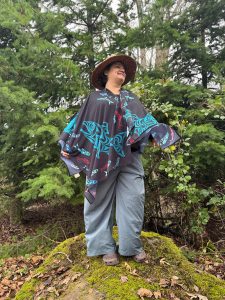
Angela Letoi | Photograph by Julie Trimingham
Skwetslatse’elho’t Si’li’xw’tunawt Angela Letoi is a caretaker and traditional storyteller. On her mother’s side, Angela is Nooksack; on her father’s side, she is Lummi. Along with her mother, Tammy Cooper-Woodrich, Angela is co-founder of the non-profit Healing Through Hope, sharing culture and stories to promote wellness. They have a children’s book based on the blue jay story forthcoming in 2026, which will be available at Village Books and Paper Dreams.
You’ve just given me a balm made from cottonwood. Thank you! The first time we met, I remember you had jars of Labrador tea. Do you gather many plants?
Cottonwood, St John’s wort. We get plantain and we get comfrey. Devil’s club. Fireweed. huxmin. Plants have a way of calling you to them, like they know when they’re needed. One of my sisters is a plant person, she was going to gather the tea we drink at the longhouse. Somebody has a cough, Labrador tea will clear it up. My sister said she knew a spot for it not far from my home. And she’s like, Do you want to come with me? Sure. So I went with her, we literally had to crawl over bushes, under trees. When we got to where the Labrador tea should be, my sister’s like, It’s so weird. It should be right here but it’s not. She starts digging around for it. I’m a wanderer, right? She’ll stay right in one spot. Me, I’m going around and looking up and looking down. I get around the corner, and I see acres of it. My sister said, These plants, your ancestors, were calling you here. They were telling you to come here. That was one of my first connections, where I realized that I was actually being called to them, and it became my job to go and get it for our smokehouse. It’s a deep interconnectedness.
Do you feel that kind of interconnectedness with storytelling?
My mom has always told stories. We were at a festival once and my grandma said to me, You need to get up there and tell a story. And I was like, Grandma, I don’t want to tell a story. I don’t know stories. And she was like, Yes, you do. You’ve listened to your mom your whole life. You need to get up there and tell it. And I was like, Okay, well, I guess I’ll tell basket woman. Because that’s the only one I could remember. I told that story for probably three years, I was too scared to tell any other ones.
Later, I was working for the tribe in the housing department, and one of the elders passed away, and his brother needed my help to get the house cleaned out. The brother said to me, I didn’t know you were a storyteller. And I said, Well, I’m not really. I tell one story. And he said, Well, I have a couple stories and I’d love to gift them to you. And I was like, Okay. So I went down to Olympia, which was where he lived, and he told me the stories. He allowed me to record them so that I could listen to him over and over. The stories were from the Fraser Valley, up in Canada, where my grandma is from. One of the stories was how crow got his voice. The other story he told me was blue jay.
He told it to me, and then he said, It’s your story now, and you can do whatever you want with it. That summer, I was on stage at a festival, and I said, I’m going to tell the blue jay story. But then a totally different story came out of my mouth. After, I apologized to everybody, saying, I guess I’m not ready to tell that story. It’s not mine yet.
I needed to understand the story. So I went up to the mountain. I needed to clear my mind. I was just sitting there, and then blue jay showed up. I listened to how he talked, watched what he was doing, felt a connection, not physical. Spiritual. And then, some time later, I went bear hunting with my son. We got to the spot where the bear usually are. We’re standing there and all of a sudden, five blue jays came. And I was like, I guess I’m supposed to tell you the blue jay story. So I told it to my son then and there. After that, I can tell it no problem.
You and the bird. The interconnectedness.
I mean, even the elder, right? I didn’t know him. I didn’t call him and be like, Oh, I’m a storyteller. You know what I mean? He came to me. And for the blue jay story to come from where my family came from, there’s no like denying that connection. You have to have your ears open in order to hear it. You’re being told something, and you need to listen, you know? For a long time, I was the one that didn’t listen. For so many years. I was off and running, and it took me until I became a really big adult to learn.
And now you have stories to tell. Hy’shqe, Angela.
Julie Trimingham
Julie Trimingham is a mother, writer, and non-tribal member of the Sacred Lands Conservancy (SacredSea.org), a Lhaq’temish-led non-profit dedicated to protecting Native sovereignty, treaty rights, sacred sites, and the life and waters of Xw’ullemy (the Salish Sea bioregion). Her heart is filled by the work to protect and promote ancestral place-based knowledge so that we can all learn to live here, with one another, and with Mother Earth, in a good way.