
“One great thing about living in the Pacific Northwest,” a local writer said at a recent First Friday, “is that I can visit just about every gallery and studio here. In New York, or other bigger cities, it’s impossible to see everything.”
That raises an interesting question—do you need to be seen in New York to have a successful career as an artist? Or an actor? Or a musician? While New York may seem like the holy grail for artists, it is more and more accessible online, so how important is it for artists to cross the country—or an ocean or two—to show their art?
There is not a simple answer—or any answer, really. But there is a growing awareness that art is art is art, and you can find and support inventive, talented artists in towns and cities all across the country and the world, including Bellingham, as well as in New York.
Two such artists, Garth Amundson and Pierre Gour, have an astonishing show at The Lightcatcher right now, in fact, called “Not The Whole Picture.” Amundson is a Professor of Interdisciplinary Arts-Photography at Western Washington University, and Gour is Professor of Studio Arts-Foundations there. Their collaborative work encompasses photography and painting. The featured pieces are several huge wheels of photos—some 18 feet in diameter—hand-stitched together into kaleidoscopes of time. This show would be a hit anywhere from the Museum of Modern Art to the International Center for Photography in New York to The Lightcatcher, where it is a smash.
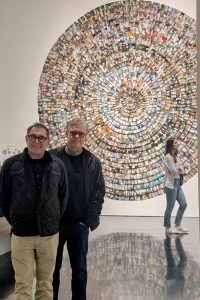
Pierre Gour and Garth Amundson
They are well aware of the prestige involved in being an active part of the art scene in New York and mindful of giving their students exposure to that as part of their education. For nearly ten years, including this year, they have taken a group of twelve students to New York in a program called Metro Art Access. Students spend nearly two weeks visiting museums and art galleries, meeting with artists who have made the transition to New York and people knowledgeable about the art scene in the Big Apple.
Film photography artist Franchine Ninh, one of the people who has been to New York with Garth and Pierre, talked about the big city/little city conundrum. “We did meet with a creative executive at Conde Nast who talked about her journey as an artist photographer. She said you have to be ready to connect, to starve, to work.”
Debbi Kenote, an artist who works in shaped paintings, got her BFA from Western and then headed to Brooklyn College for an MFA. She says she began showing ‘for real’ three or four years ago at several places in New York. She acknowledges the opportunities in New York and its draw for artist and viewer alike: “I definitely get Pacific Northwest people coming to see my work here,” she says. While she has adjusted to the pace, the variety, and the sheer amount of art at her fingertips, she also says that “the trips home definitely inform my practice. The Pacific Northwest is a constant inspiration.”
According to Artfacts, most of the art galleries in the world are located in the United States, Europe, and Asia, with over 20% of them located in just five different cities: New York (6%), London (5%), Berlin (4%), Paris (3%), and Los Angeles (3%). That leaves a lot of collectors and people who are interested in seeing art everywhere else, making the point that, well, you may not need to be in New York.
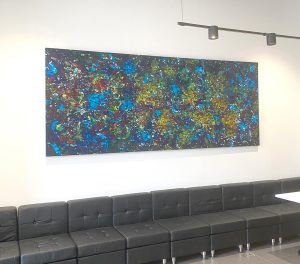
David Syre | Untitled, 2016, Lobby of TACONIC & Partners, New York
A case in point is David Syre, self-taught artist whose work shows at Cordata Gallery in Bellingham. (Full disclosure, the author of this article owns a Syre painting.) In spite of having sold several large pieces to collectors in New York—he has a piece hanging in the Taconic Partners Hudson Art Center—he is a rooted Bellingham legend whose success was firmly in place without being in New York.
“We’ve definitely been conditioned to believe that exhibiting in “The City” is the end goal,” says Garth Amundson. “The mythological formula has always been to show in a big celebrated museum group show—like the Whitney biennial, New Museum, or ICP—then you’ll be picked up by a commercial gallery, and VOILA!” Amundson and Gour, and without New York necessarily, have taught at the College of Wooster in Ohio, lived and taught in Canada, had a Fullbright (Garth) to Morelia, Michoacán, Mexico, and, together, had a three-month Residency in the Czech Republic. They have had shows all over the world.
“Even though NYC still holds its position as an art center, it’s obvious that Europe—Paris, London, Berlin, Madrid—also set the standard,” they said. “The Whitney broke from NY-centric tradition in 2000 and tried to mix things up by inviting curators from across the country to participate. Suddenly they were showcasing work from all over—Texas, Michigan, even Seattle, WA—and they’ve been doing it ever since!”
Young artists—and maybe the cost of living and travel—may also be changing the dynamic. Dharmar Acosta, another participant in the MetroAccess trip to New York, put it well: “I think the most important thing is being social, making friends, and networking. When you’re an artist, it’s easy to put your head down but it’s important to put yourself out there. That’s true in both small towns and the big city.
Franchine Ninh summed it up: “It’s like the romanticization of NY. I am definitely a victim of that with daydreams of going to New York, but I don’t think I ever made the commitment to do that because all of my roots are here. There are a lot of working artists here that are successful. Every year that I am alive on this earth it pushes me to get involved with the art community locally.”

Franchine Ninh | Koi and Lotus