


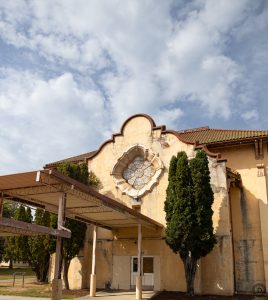
The grounds look like something one might see in Tuscany—creamy stucco buildings topped with terracotta roofs, with the Cascade mountains as a backdrop. The faces who peered from the windows during the property’s heyday, however, weren’t European vacationers—they were patients struggling with inner demons. Schizophrenia or bipolar disorder. “Exhaustion” and “dementia.” Addiction.
Photograph by Desiree Sauve
The beautiful campus was the “Western State Hospital Farm for the Harmless Insane,” originally established in 1909 to aid the overcrowded Western State Hospital. Patients worked the farms as occupational therapy, and the hospital provided jobs for the town of Sedro-Woolley. The hope was that patients would find relief in purposeful work, fresh air, and natural beauty, and later be able to return to society as functional members. The farm soon became an institution in and of itself, known as Northern State Hospital, and treated patients from the 1910s to the mid-1970s.
During this time, doctors tried many forms of “therapy,” from insulin comas, electric shock therapy, and hydrotherapy to lobotomies and sterilization. Some patients were able to return to society, others stayed for the rest of their lives (or until the hospital closed its doors), and some died there.
Photograph by Allison Holm
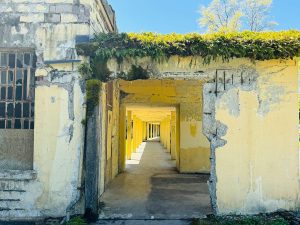
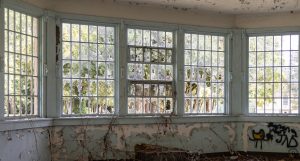
During the 1960s, smaller mental health centers started replacing larger institutions and, despite protests from the Sedro-Woolley community, Northern State eventually shut its doors in 1973. Many people lost their jobs, and patients often found themselves without support. Over time, the buildings slowly deteriorated—and, along with them, the stories and voices of those who spent so much of their lives there.
A Sunken Cemetery
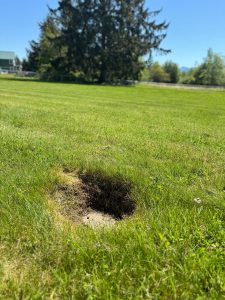
The hospital grounds are now part of the Northern State Recreation Area. A few of the old buildings are used for job corps projects and drug rehabilitation. A cemetery flanks Highway 20—nothing more than a flat plot of grass. If you look closely, you can see small cement stones dotting the field, crudely marked with patient initials or numbers. These are the headstones of the unclaimed Catholic patients—the rest of the unclaimed bodies were cremated on campus and stored in tin food cans in the morgue attic. Between 1946 and 1952, most of those cans were buried at the Northern State cemetery in unmarked graves. 204 of the remaining cans were buried at Hawthorne cemetery in Mount Vernon. Most of the markers in the cemetery have sunk beneath the soil. Some still peek from beneath the grass; the only evidence left of someone who lived and died at Northern State.
Photograph by Allison Holm
One man is determined to uncover as many of those markers—and stories—as he can.
John Horne used to work as a chemical dependency counselor on the Northern State campus before it closed in 2023. He believes that the original cemetery is larger than its current two acres, and that the bodies of at least 200 patients are buried beneath the trees north of the property.
Photograph by Desiree Sauve
A few years ago, Horne started tending to these markers, delicately edging along headstones and marking them with flags. He’s uncovered more than 200 stones and identified 300 more beneath the surface. He’s able to match the initials on some of the markers to burial records and has helped some family members gather bits of information on their long-lost loved ones. It’s thought that close to 1,800 patients are buried on the campus or in the surrounding valley (this includes those cremated and stored in cans).
Why would a volunteer put such care into this old, forgotten cemetery? John explains that he has always loved old, abandoned buildings and cemeteries:
“Not for the creepy factor, but because of the people who were there. Every person has a story, and I’ve always felt that these stories should be preserved. I’ve always loved cemeteries because they’re full of forgotten stories.”
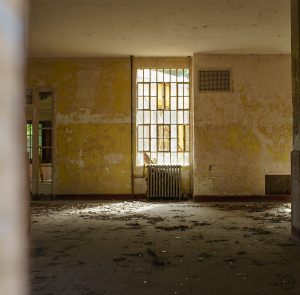
Photograph by Desiree Sauve
The ground isn’t so willing to let the headstones out of its grasp. After winter’s freeze, the land becomes waterlogged, sucking the stones under again. But Horne continues to return each spring, preserving what he can.
Horne reflects: “The Northern State cemetery is important to me, because it’s full of lives that no one cared to preserve or remember. When a small block of concrete with an initial on it is all that’s left of someone’s story, people should at least be able to see it. Once that marker is gone, there will be nothing left of that person. I think everyone deserves better than that.”


